
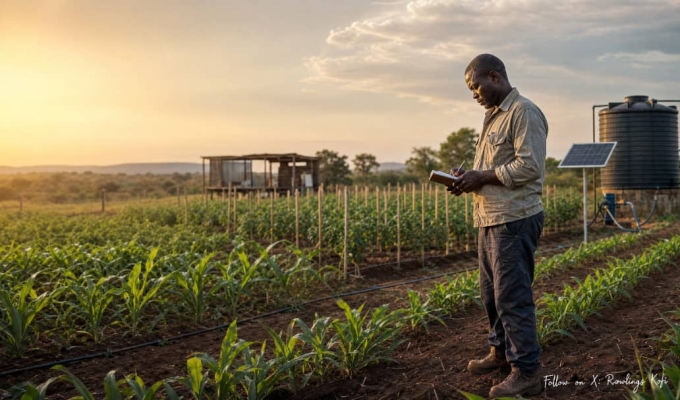
By Rawlings Kofi
A farmer who has survived drought, a failed crop, delayed payment, or a market-price crash does not need a lecture about being careful. Caution is earned.
In Zimbabwe, farming is exposed to real shocks. Drought is the country’s most important agricultural risk, and the sector is estimated to lose roughly US$126 million a year to production risks. [1] In the south, smallholders face erratic rainfall, mid-season dry spells, heat, frost, floods, weak irrigation access, and tight cash. [2] [3]
So when a farmer says, “Let me keep my money,” that is not stupidity. It is a survival response.
But survival thinking can become expensive when it turns into a permanent operating system. When every decision is driven by fear of loss, the farm avoids bad risks—but it also misses good opportunities. Land stays in a familiar crop without a market comparison. Cash sits without a working-capital plan. Equipment is repaired only after it fails. A better buyer is never approached because the present buyer is “safer.”
That is where caution becomes a farm cost.
Scarcity Thinking Is Not the Same as Being Poor
Scarcity thinking is what happens when your decisions are controlled by the fear that there will never be enough: not enough rainfall, cash, inputs, labour, buyers, or time.
It can make a farmer protect every dollar so fiercely that the dollar never does any work. It can make a farm hold onto a low-return enterprise because it is known, even when a small, controlled trial could reveal a better use of land. It can make the owner work until exhaustion because hiring one person feels like a cost, while the lost value of the owner’s time remains invisible.
The issue is not that farmers should stop saving money or stop respecting risk. The issue is whether the farm has a decision rule.
| Careful farmer | Frozen farmer |
|---|---|
| Keeps a planned liquidity reserve. | Holds all cash with no purpose or deployment plan. |
| Tests a new enterprise on a manageable scale. | Refuses every new enterprise because the last bad season still controls the decision. |
| Uses a normal-case budget and a bad-case budget. | Uses hope, rumours, or last season’s price. |
| Diversifies deliberately across crops, buyers, or seasons. | Tries many things without records, or sticks to one thing blindly. |
| Buys inputs and repairs based on a margin calculation. | Delays productive spending until failure becomes more expensive. |
A careful farmer asks, “How do I protect the downside?” A frozen farmer asks, “How do I avoid making any move?” Those are not the same question.
The Opportunity Cost of Playing Only Defence
The first economic principle is opportunity cost: the value of the next best option you gave up.
A farmer can see the money spent on seed, fertilizer, or labour. What is harder to see is the money not earned because land, capital, and time were never put into their best available use.
Take irrigated land. Growing a familiar grain crop may be the right decision if it protects food security, fits the water supply, and has a clear market. But it becomes an expensive habit if the farm never checks whether part of that land could earn more through a winter vegetable trial, a contracted seed crop, or another enterprise suited to the location.
The same applies to cash. A cash reserve is wise. Yet money kept aside for no defined purpose is not automatically safe. It may be missing the chance to finance a high-confidence activity: a pump repair that prevents yield loss, a bulk input purchase that lowers unit cost, or a small enterprise that already has a buyer.
The same applies to the farmer’s time. If the owner spends every day doing work that a trained worker could do, who is checking costs, calling buyers, comparing input quotes, watching the market, and planning the next season? A farm owner is not only a labourer. The owner is the chief allocator of land, money, labour, and risk.
That job has a return. Neglecting it has a cost.
A Higher Margin Is Not Automatically a Better Enterprise
Now we need to be honest about the opposite danger.
A farmer hears that tomatoes paid well in winter. A neighbour posts a good price from Mbare Musika. Suddenly, everyone wants tomatoes. That is how markets become flooded.
Zimbabwe’s tomato market shows exactly why a gross-margin table cannot stand alone. In February 2026, the Agricultural Marketing Authority reported that increased supply had pushed Mbare Musika tomato prices down to US$1.10/kg from US$1.30/kg. [4] A few months later, a winter shortage was reported to have lifted wholesale prices to roughly US$50–US$60 per 30kg crate. [5]
The lesson is not “grow tomatoes.” The lesson is do not plant a crop because the last price was attractive.
A high-margin enterprise may carry higher cash requirements, pest pressure, labour demand, transport costs, rejection risk, and price volatility. Tomatoes cannot wait in storage for a better week. Maize has different economics: it is less perishable, more familiar to many farmers, and can be stored when conditions allow. The right choice depends on the farmer’s water, cash flow, production skill, harvest window, buyer access, and tolerance for loss.
That is risk-return analysis. Profit is not one number. It is the return left after you consider what can go wrong, how likely it is, and whether your farm can survive it.
A margin on paper is only a possibility. A margin after market timing, spoilage, transport, debt, and rejected produce is the business.
The One-Hectare Decision: Protect the Downside, Pursue the Upside
Consider an illustrative farmer with one hectare of irrigated land. The farmer normally grows maize. This season, the farmer is considering tomatoes after hearing that winter prices can be strong.
There are two poor decisions.
The first is to put the whole hectare into tomatoes because last winter’s prices looked attractive. There is no confirmed buyer, no record of the farm’s actual tomato costs, no cash reserve for disease control, and no plan for a price drop. That is not entrepreneurship. It is a large bet disguised as ambition.
The second poor decision is to refuse to test tomatoes at all, even though the farm has water, suitable land, some management capacity, and a possible market window. That is not necessarily prudence. It may be fear using tradition as a shield.
The strategic decision sits in the middle. The farmer retains a core area in the familiar enterprise to protect food and cash flow. Then the farmer allocates a small, affordable plot to tomatoes—but only after doing the work before planting.
| Before the trial | Why it matters |
|---|---|
| Check the expected harvest window against likely market supply. | A good crop entering a flooded market can still lose money. |
| Identify at least two possible buyers, or secure a pre-season arrangement where possible. | One buyer does not make a market. |
| Budget the normal case and the bad case. | A plan built only on the best price is not a plan. |
| Separate household money, emergency money, and trial capital. | The farm must survive a trial that disappoints. |
| Record every cost: seedlings, chemicals, labour, crates, transport, rejected fruit, and credit. | You cannot scale what you have not measured. |
| Expand only after the trial proves a repeatable margin. | Growth should follow evidence, not excitement. |
This is marginal analysis in practical clothing. Do not ask, “Should I change my whole farm?” Ask, “Will the next manageable piece of land, capital, and labour produce a return that justifies the extra cost and risk?”
If the answer is yes, test it. If the test works, expand carefully. If it fails, the farm has bought information at a price it could afford.
Diversification Is Not Doing Everything
Many farmers hear “diversify” and start a poultry project, plant vegetables, keep goats, open a tuckshop, and buy bees—all in one season. That is not diversification. That is confusion with several expense accounts.
Economic diversification means spreading exposure in a deliberate way. A farmer might combine a staple crop that supports household food and cash flow with a smaller high-value crop that has a verified market. Another farmer might use one buyer for a contracted portion and keep another portion for a spot market. A livestock farmer might improve fodder planning while building a modest side enterprise that has a different sales cycle.
The point is not to own many enterprises. The point is to avoid having every enterprise fail for the same reason at the same time.
Rain-fed maize and rain-fed tomatoes planted in the same area at the same time may not provide much protection if a dry spell comes. A winter crop supported by irrigation, a stored grain position, and a small contracted enterprise may spread risk more intelligently. The right mix will differ by farm. There is no universal recipe.
Liquidity: The Difference Between a Reserve and Fear
Liquidity means having cash or resources you can access when the farm needs them. It matters because agriculture does not pay bills every day, but it produces bills every day.
A liquidity reserve has a purpose. It covers the next critical spray, fuel for irrigation, labour at harvest, transport to market, or a household emergency that could otherwise strip money from the farm. The amount should be planned before the season, not discovered after the money is gone.
Scarcity thinking says, “Never spend.” Strategic growth says, “Know what must remain untouched, then put the rest to work only where the return and risk make sense.”
That distinction matters. A farm with no reserve can be forced to sell at a bad price. A farm that never invests cannot improve. The disciplined farmer protects a buffer and gives the remaining capital a job.
The Five-Question Gate Before You Commit Land, Cash, or Labour
Before the next enterprise decision, sit down with a notebook. Do not make the decision at the agro-dealer, in a WhatsApp group, or after hearing one good market story.
| Question | What the answer should reveal |
|---|---|
| 1. What can go wrong, and can this farm survive it? | The real downside: poor yield, lower price, delayed buyer payment, disease, water interruption, or higher transport costs. |
| 2. What price and yield am I budgeting for? | Whether you are using a normal case and a bad case—not only the best case. |
| 3. Who will buy, when will they buy, and what happens if they do not? | Your market plan, buyer alternatives, product-quality requirements, and selling costs. |
| 4. What is the smallest test that gives me useful evidence? | A trial scale the farm can finance and learn from without risking the whole business. |
| 5. What cash must stay untouched? | The liquidity reserve that protects the season and the household. |
Write the answers down. The act of writing forces the farm to move from emotion to evidence.
Growth Does Not Mean Gambling
The goal is not to turn careful farmers into reckless farmers. Zimbabwe has seen too many seasons where a good idea was destroyed by poor timing, drought, weak markets, or cash running out halfway through production.
The goal is to move from a farm that reacts to fear into a farm that prices risk, manages it, and learns from each season.
Do not bet the whole farm on a rumour. Do not keep the whole farm trapped in yesterday’s fear either. Build a budget. Protect a reserve. Find the market. Trial the idea. Measure the result. Then decide whether to expand.
You do not build resilience by avoiding every risk. You build it by understanding risk, pricing it, and managing it.
Strategy over sweat. Always. 🇿🇼
