
By Rawlings Kofi, Agribusiness Specialist
In the dynamic world of agriculture, every farmer understands the importance of a good harvest. The sight of bountiful crops is the ultimate reward for months of hard work, dedication, and investment. However, a large harvest doesn't automatically translate into large profits. The true measure of success in agribusiness lies not just in what you grow, but in how efficiently and profitably you grow it. This is where understanding fundamental economic principles, such as the Principle of Substitution, becomes absolutely critical for African farmers.
What is the Principle of Substitution?
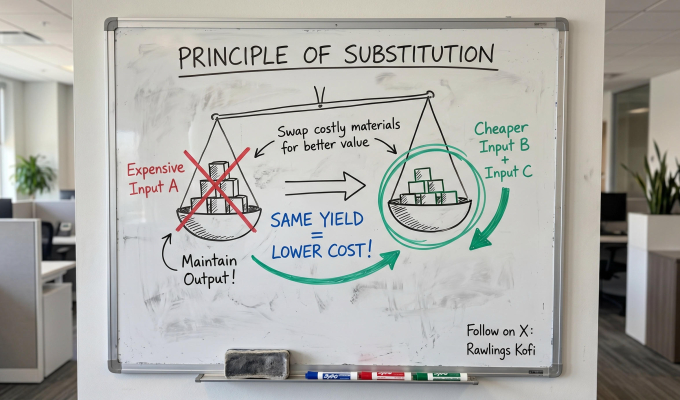
At its core, the Principle of Substitution, also known as the Principle of Least-Cost Combination, is about achieving the same desired output (your harvest) by using the most cost-effective combination of inputs (resources). It challenges the traditional mindset of sticking to a fixed set of inputs, regardless of their fluctuating prices. Instead, it encourages farmers to be agile, constantly evaluating and swapping more expensive resources for cheaper, equally effective alternatives.
Think of it like this: if you can achieve the same yield of maize using a different brand of fertilizer that costs less, or by adjusting your planting density and irrigation schedule to reduce chemical inputs, why wouldn't you? The goal is to maintain or even improve your output while simultaneously driving down your production costs. This isn't about cutting corners; it's about smart, strategic resource allocation.
Why This Matters for African Farmers
African agriculture faces unique challenges: volatile input prices, climate change impacts, and fluctuating market demand. In such an environment, blindly following traditional practices or relying on a single input strategy can be a silent killer of profit. The Principle of Substitution offers a powerful antidote:
- Input Price Volatility: Prices for fertilizers, seeds, and chemicals can change dramatically. Farmers who understand substitution can quickly adapt, finding alternative inputs or methods when traditional ones become too expensive.
- Resource Scarcity: Water, land, and specific types of labor can be scarce. This principle encourages innovative thinking to replace scarce or expensive resources with more abundant or affordable ones.
- Environmental Sustainability: Often, more sustainable practices can also be more cost-effective. Substituting synthetic fertilizers with organic compost can reduce costs while improving soil health.
- Increased Competitiveness: By lowering production costs without sacrificing yield, farmers can become more competitive in both local and international markets.
Practical Application: Beyond Theory
Let's consider a few real-world scenarios where the Principle of Substitution can be applied:
- Fertilizer Management: If the price of nitrogen fertilizer skyrockets, a farmer might explore increasing the use of nitrogen-fixing cover crops or integrating livestock manure.
- Pest and Disease Control: Instead of expensive chemical pesticides, a farmer could implement integrated pest management (IPM) strategies, such as crop rotation or pest-repellent companion crops.
- Labor vs. Mechanization: If labor becomes scarce, small-scale mechanization might be a cost-effective substitute. Conversely, if labor is abundant, manual methods might be preferred over costly machinery.
- Feed for Livestock: When commercial feed prices rise, livestock farmers can explore substituting with locally grown forage or by-products from other agricultural processes.
The Mindset Shift
Adopting the Principle of Substitution requires a fundamental shift in mindset. It moves farmers from being passive recipients of input prices to active managers of their production costs. It demands:
- Continuous Learning: Staying informed about alternative inputs and new technologies.
- Record Keeping: Meticulous records of costs, yields, and prices are essential to compare efficiency accurately.
- Experimentation: Willingness to test new approaches on a small scale before full implementation.
Your Farm, Your Future
The Principle of Substitution is not just an academic concept; it is a vital tool for resilience and profitability in African agribusiness. By consciously seeking the least-cost combination of resources, Zimbabwean farmers can transform their operations from mere subsistence to thriving, sustainable businesses.
It's about working smarter, not just harder. It's about making every dollar count and ensuring that your hard-earned harvest translates into genuine profit. Embrace the power of substitution, and unlock a more prosperous future for your farm.
Follow on X: Rawlings Kofi https://x.com/kofi_rawlings
