
Michelle Chifamba,
HARARE; China’s push to strengthen Zimbabwe’s agriculture sector launched the Juncao technology pilot project in 2025, a year later the project is being commended as an agricultural game-changer that has transformed lives, improving food sustainability and eradicating poverty for rural and urban small-scale farmers in Zimbabwe.
The Juncao technology is a comprehensive technology that utilizes Juncao grass to cultivate edible and medicinal mushrooms, produce livestock feed and fertilizer, promoting ecological and environmental governance.
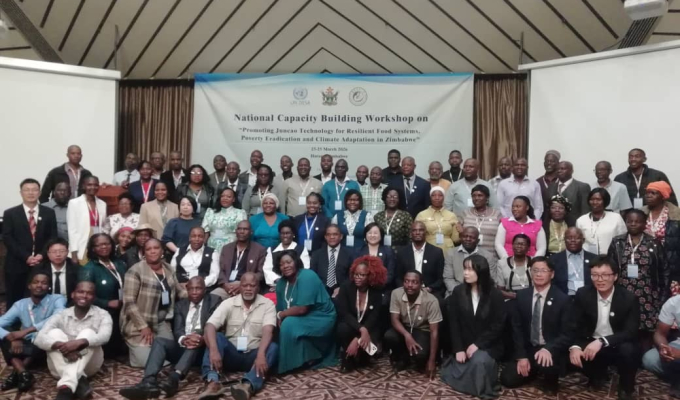
The Ministry of Lands, Agriculture, Fisheries, Water and Rural Settlements in partnership with the National Engineering Research Centre for Juncao Technology of the Fijian Agriculture and Forestry University of China convened a capacity building workshop, themed ‘National Capacity Building Workshop on Promoting Juncao Technology for Resilient Food Systems, Poverty Eradication and Climate Adaptation in Zimbabwe,’ in Harare this week to strengthen national capacities and promote the adaption, implementation and scaling of Juncao technology as a science based solution for resilient food systems, poverty eradication and climate adaption for small-scale farmers in Zimbabwe. The workshop also included field visists to Juncao demonstration sites in Gwebi Agricultural College and Chinhoyi University of Technology, local mushroom farmers in strengthening capacities to promote the adoption, implementation and scaling Juncao technology as a science based solution for resilient food systems, poverty eradication and climate adaptation.
A New Chapter in Agriculture Transformation
In his keynote address during the capacity building workshop, Permanent Secretary for Lands, Agriculture, Fisheries, Water and Rural Development, Professor Obert Jiri said the Juncao technology has immerse potential in transforming Zimbabwe’s agriculture sector for economic growth, food and nutrition security and eradication of poverty.
“The Juncaon technology is a powerful tool that can help Zimbabwe to transition from a low-income to a middle-income status economy. We are moving beyond the traditional, fragmented approach of mushroom production. The Juncao technology offers a paradigm shift offering a sustainable, low-cost and readily available alternative to traditional materials enabling year-round production and empowering farmers with news skills in production,” said Professor Jiri.
Zimbabwe is stepping up efforts to drive inclusive growth and accelerate economic development under its Vision 2030 agenda. Agriculture is positioned as a key pillar for food security, improving rural livelihoods, poverty eradication and economic expansion. The country has strengthened its partnership with China to adopt innovative agricultural technologies aimed at improving productivity and transforming smallholder farming. The deepening cooperation is also expected to support Zimbabwe’s progress towards achieving the United Nations 2030 Sustainable Development Goals.
“In the long term, this technology can be integrated into our Village Business Units, Youth Business Units and agribusiness like cooperatives. This integration will create new value chains, from mushroom production to feed manufacturing, fostering green jobs and catalyzing economic activity at the grassroots level. This is a direct contribution to our goal of establishing Zimbabwe as an agro-processing hub, moving beyond mere production of raw commodities,” said Professor Jiri.
China-Zim relations embedded in promoting SDGs, aligning with National Programs
The four day workshop which sought to enhance participants’ technical knowledge and practical skills across the Juncao value chain, particularly mushroom production, livestock feed and environmental applications facilitated policy dialogue, institutional coordination, and South-South knowledge exchange was attended by government officials, academic institutions, farmers and development partners. Field visits at Gwebi Agricultural College and Chinhoyi University of Technology brought together experts from the Ministry of Lands, Agriculture, Fisheries, Water and Rural Development and the National Engineering Research Centre for Juncao Technology at the Fujian Agriculture, engaging with women and youth towards the employment of sustainable agrifood systems, leveraging emerging opportunities presented by Juncao technology for the achievement of Sustainable Development Goals.
“As we work to increase our national cattle herd from 5.7 million to 6.6 million by 2030, and boost milk production by 75 percent to 200 million litres, the resilience of Juncao grass to climate shocks provides a reliable source of high-quality silage, safeguarding our farmers against increasing droughts and climate variability that threaten our livestock sector.
“The government is deeply committed to scaling up the Juncao technology aligning with national programs. Our strategic interventions such as the establishment of 35,000 Village Business Units are designed to be the very platforms where Juncao technology can be deployed for maximum impact. We implore research stations, agricultural colleges and universities to take up the challenge of research in creating knowledge base and propagation sites needed to support its national roll-out,” Professor Jiri said.
Empowering farmers- changing lives
Small-scale farmers have commended the new Chinese Juncao technology that is improving crop yields, supporting small businesses and smart agriculture in the midst of climate change.
Dairy farmer, Godknows Masunda says since adopting the Juncao technology, farming has become more viable and economically productive.
“Through Juncao technology, farming has become more viable for urban small-scale farmers providing prolific growth, sustainable food production and climate resilience,” Masunda said.
Other urban farmers benefiting from the technology say, the Juncao grass species’ multiple purposes including Juncao grass as the culture substrate for cultivating edible mushrooms, produce livestock feed and fertilizer, to promote soil conservation and desertification control, the production of paper, fiberboard, textile and biomass energy.
“Its integration offers a powerful pathway to improve agriculture and food systems sustainably. Juncao technology enables low-cost, efficient mushroom cultivation without relying on timber, making high protein, micronutrient-rich food accessible to smallholders, diversifying diets and creating a valuable cash crop. The Juncao grasses are also high-yielding, nutritious fodder for livestock, improving meat and milk production. The Juncao grass has deep roots that prevent soil erosion and rehabilitate degraded land such as saline soils and improve retention,” said Jane Mugweni, Juncao grass farmer based in Harare.
In partnership with China, countries are adopting to the Juncao technology because of its low-cost, nature based solution that addresses challenges of food insecurity, environmental protection, employment creation and poverty reduction.
_large.jpg)